
Charitable trusts, explained in plain English.
If you've got an appreciated asset and a tax bill you'd rather not pay all at once - and you're not sure whether a charitable trust, a donor-advised fund, or something simpler is the right move - that's exactly the conversation we're here for. Plenty of people come to us for the tax and income side first; the gift at the end is the outcome, not the requirement. We'll walk you through the options, usually with a visual, and help you decide what fits.
"You'll leave the first conversation understanding your options - whether or not you ever become a client."
Start with the visual.
Most people find a charitable remainder trust easiest to understand as a diagram. Here's the shape of it: you give an appreciated asset, you skip the capital-gains tax on the sale, you get a deduction and an income stream, and whatever's left at the end goes to a charity of your choosing.
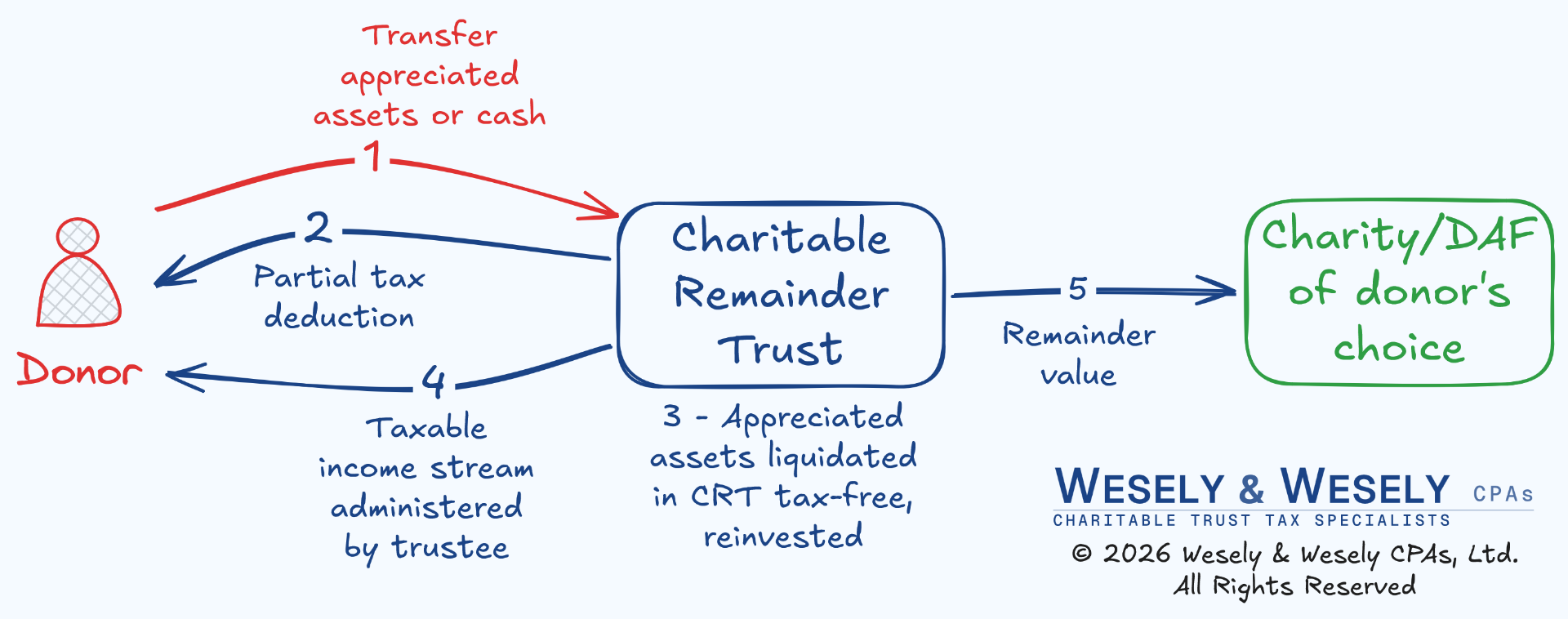
This is the kind of diagram we'll draw with you - not a wall of tax code. If a trust isn't the right tool for your situation, we'll show you the simpler ones too.
You don't need to know the jargon.
"I have stock that's grown a lot. If I sell it, the tax bill is huge. Is there a better way?"
Often, yes. Giving the appreciated asset directly - to a trust or a donor-advised fund - can skip the capital-gains tax entirely, get you a deduction, and, with a trust, pay you an income stream. We'll show you the difference in real numbers.
"I want to give, but I also need income. Can I do both?"
That's the whole idea behind a charitable remainder trust. You give the asset, receive income for life or a set term, and the remainder goes to charity. We'll model whether the numbers work for you.
"My advisor mentioned a CRT. Should I be looking at one?"
Maybe. A trust is the right fit less often than people expect. We'll tell you honestly whether it suits your situation - and point you to something simpler if it doesn't.
"This all sounds complicated. Where do I even start?"
With a conversation - no charge, no commitment. Thirty minutes, plain English. If we're not the right fit, we'll usually know who is and point you there.
Is a Charitable Trust Right for Me?
A short, jargon-free guide to the three things that have to line up for a charitable trust to make sense - and the simpler options worth considering if they don't. Written to read in one sitting, with a diagram, so you can think it over (or talk it over with your family) before you call anyone.
A few short reads.
Is a charitable trust right for me?
The three things that have to be true for a charitable trust to make sense - in plain English, with the simpler alternatives if one of them is missing.
How we work
What to expect if you reach out: the first call, what it costs, how long things take, and what you'll actually receive.
What a charitable remainder trust actually is
The whole idea in five plain steps, with a visual - and why you don't have to think of yourself as "charitable" for it to make sense.
Not sure if any of this applies to you? Let's just talk.
Tell us a sentence or two about what you're thinking. The first conversation is free, in plain English, and there's no obligation.